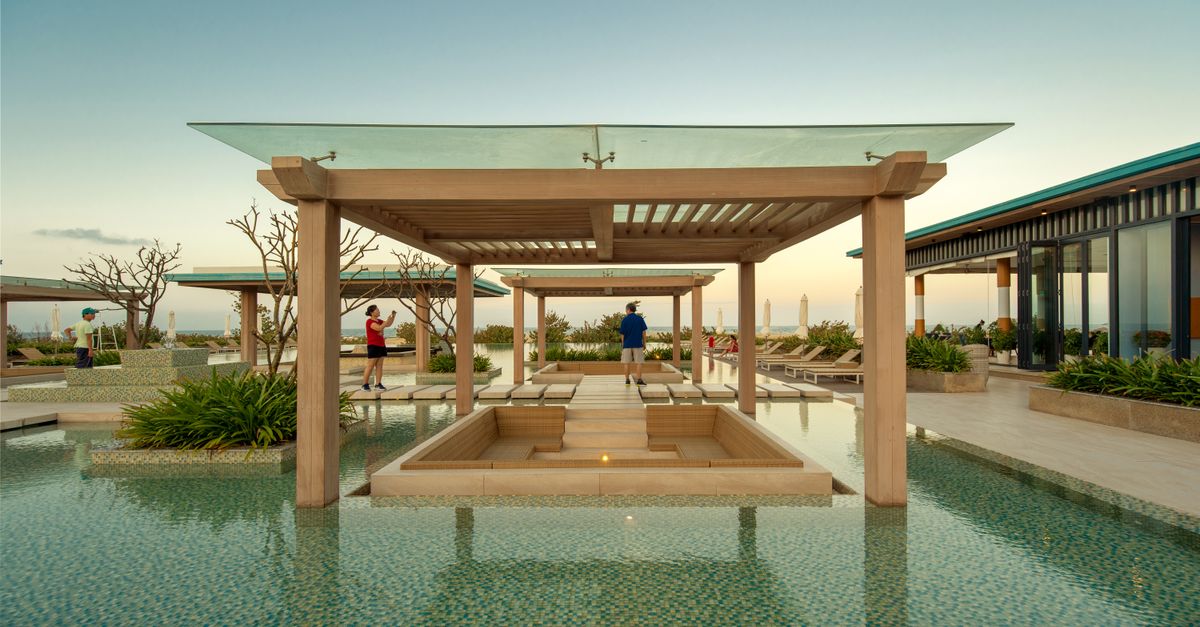
The contradiction appears straightforward: hospitality companies grow through scale. More rooms, more occupancy, more market share, more revenue diversification. Yet since 1988, Aman Resorts has built one of the world’s most profitable ultra-luxury hospitality empires by doing the inverse. Founder Adrian Zecha imposed a hard ceiling: no Aman property exceeds 50 rooms. No group bookings. No conference facilities. No algorithmic upselling or mobile app notifications.
Three decades later, the model has not merely survived—it has forced a reexamination of what luxury actually means when supply is deliberately constrained.
The Economics of Scarcity
Aman’s founding insight was not philosophical alone; it was commercial. Zecha recognized that at the ultra-premium tier (defined as nightly rates exceeding $1,500–$10,000+), clients no longer purchase hospitality services. They purchase absence. Absence of crowds, noise, commercial artifice, and decision friction.
This reframe inverted the entire value chain. Traditional luxury hotels—Ritz-Carlton, Four Seasons, Peninsula—compete on amenities: spa capacity, restaurant counts, room configurations. Aman competes on subtraction. Fewer rooms means fewer guests, which means:
- Higher occupancy economics per square foot
- Elimination of cannibalistic pricing (no need to discount rooms when every night is booked months ahead)
- Ability to charge rates that would seem absurd if divided across 300-room properties
- Premium per-guest service labor (staff-to-guest ratio inverts toward abundance)
The mathematics work. A 40-room Aman property generating $1.5M per room annually ($55M total revenue) outperforms a 250-room luxury competitor generating $600K per room (only $150M total). The Aman property requires fewer infrastructure costs, smaller supply chains, minimal corporate overhead.
Refusal as Brand Architecture
Aman’s constraint operates as a screening mechanism. By refusing group business, by declining price sensitivity, by designing spaces that actively discourage day-trip tourists, Aman constructs a protected market segment.
This is not accidental. It is operational philosophy embedded in every decision:
Capacity ceilings. No property scales beyond what one general manager and a tight leadership team can oversee personally. Zecha believed (correctly) that scale breeds mediocrity—standardization, training programs that dilute craft, corporate-speak replacing genuine hospitality.
Architectural specificity. Each Aman adapts to its geography: Aman Kyoto references Japanese woodworking and temple aesthetics. Aman Al Manara in the Maldives is anchored to marine conservation. Aman New York occupies a reimagined 1920s Manhattan landmark. This is not franchising; it is site-specific curation. Replication would destroy the model.
Service as restraint. Aman does not compete on breadth. Two restaurant concepts, not ten. A single spa treatment philosophy, not buffet menus. The result is depth: every service available is exceptional because resources concentrate. Clients pay premium pricing partly for what exists, but fundamentally for what has been eliminated.
The Pricing Regime
Aman’s rate card is, on its surface, unreasonable. Suite nightly rates in established properties range from $1,200 to $3,500. In flagship properties like Aman Kyoto or Aman Venice, rates approach $5,000–$8,000. Aman New York residences—not hotels, residences—command seven-figure seasonal commitments.
These are not prices justified by amenity checklists. They reflect:
-
Radical scarcity. With 40 rooms at 90%+ occupancy year-round, each night is rationed. Pricing can rise to whatever the market clears.
-
Membership economics. Aman functions like a luxury club. First-time clients often book through intermediaries (luxury travel concierges, private banks, family offices). Repeat clients (who constitute 60–70% of occupancy) are cultivated as quasi-members.
-
Privacy premium. Clients are paying significantly for the guarantee that their names will not appear in hotel registries visible to other guests, that no corporate events will disrupt their stay, that discretion is structural rather than promised.
-
Philosophical alignment. Ultra-wealthy clients increasingly seek experiences that signal values beyond consumption: sustainability, cultural authenticity, wellness that is not spa-theater. Aman embodies all of this through constraint.
Scaling Without Betrayal
The 2020 acquisition by DSMG (a Dubai-based investment fund) was a capital infusion, not a pivot. Aman has opened 40+ properties since then while maintaining the 50-room ceiling. This is scaling restraint—growth through disciplined site selection, not proliferation.
The Aman New York move (2025–2026) marked a conceptual evolution. Rather than hotels, Aman now offers residences and long-term quarters. This extends the model into a new market: ultra-wealthy individuals seeking a secondary home or rotating residence in major cities, with hotel-level service and privacy. It is not a departure; it is a logical evolution of the core thesis—providing absolute peace and discretion to a client segment for whom cost is not a constraint.
Market Validation and Limits
Aman’s success has not generated imitators because the model cannot be franchised downward. A developer cannot license the “Aman experience” to a 200-room resort; the constraints that create value would dissolve immediately.
Competitors (Capella, Soneva, Four Seasons Private Residences) have adopted adjacent strategies—smaller, more curated, higher pricing—but none has replicated Aman’s orthodoxy. Most hedge with larger configurations or diverse revenue streams.
The market for Aman is also finite. An estimated 10,000–15,000 ultra-high-net-worth individuals globally constitute the core addressable market. Occupancy saturation is approaching in major cities; future growth will depend on emerging wealth centers and the residential model.
Business Lessons
Aman Resorts offers four unconventional lessons for ultra-premium brands:
-
Constraint breeds premium pricing. The refusal to scale triggers pricing power unavailable to scalable competitors.
-
Simplification creates operational excellence. Limited service menus allow obsessive refinement. The result feels like scarcity by design, not limitation.
-
Community over transaction. By emphasizing repeat clientele and membership-like dynamics, Aman shifts from transactional hospitality to curator of a global lifestyle.
-
Philosophy sustains differentiation. When every competitor can hire talented staff and source materials, philosophy becomes the only defensible moat. Aman’s philosophy—that peace has commercial value—remains unmatched.
Conclusion
Aman demonstrates that ultra-premium markets operate by different rules. Growth is not always desirable. Scale is often counterproductive. The refusal to optimize per-asset yield in favor of per-guest experience has built a company that, by conventional metrics, should not exist. Yet it does—profitably, durably, and at price points that would cause any traditional hotelier to reconsider their assumptions about what luxury actually commands.