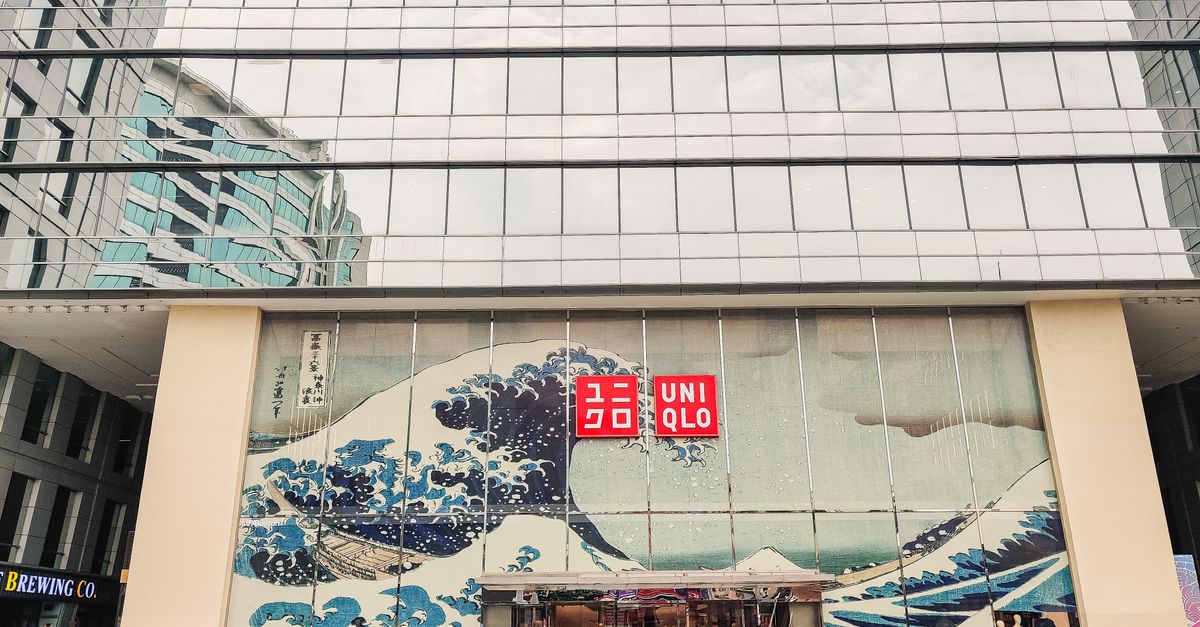
LifeWear is not a product line—it is a manifesto that positions Uniqlo at the centre of a quiet revolution in textile manufacturing: the infrastructure of everyday clothing. For three decades, Tadashi Yanai has built Fast Retailing on a deceptively simple conviction: the greatest wardrobes never announce themselves.
The Philosophy of Everyday Necessity
LifeWear rests on a premise the fashion industry often overlooks: people don’t dress for display in their daily lives; they dress to function. A perfect pair of jeans should last ten years, not impress at retail. A white t-shirt must coordinate with ninety other pieces, not demand attention. A sweater must perform in cold weather without failing after two winters.
Yanai’s vision, articulated publicly since the early 2000s, fundamentally breaks with traditional fashion industry logic, which builds itself on the cult of novelty, visibility, and planned obsolescence. At Uniqlo, innovation is invisible. It lives in the reliability of the fabric, the fit that holds after fifty washes, seams that don’t unravel, dyes that don’t fade.
This philosophy materializes in specific products: the jeans that built Uniqlo’s reputation, the heattech thermal layers that genuinely function in winter, the pima cotton shirts that resist pilling. None of these items appear in Vogue. All of them quietly transform the wardrobes of hundreds of millions globally.
Planetary Expansion: From Tokyo to Everywhere
Fast Retailing ranks as the world’s third-largest textile group, behind Inditex and H&M. This ranking itself reveals the strategy’s effectiveness: Uniqlo has never relied on celebrity or influence-driven growth. It has expanded through patient capillary diffusion, systematically placing functional stores in every major metropolitan market—places where quality speaks louder than branding.
The geography of expansion follows strict logic: cities where average income supports a premium price relative to mass market alternatives (H&M, Forever 21), but where consumers aspire to sobriety over visible logos. Tokyo, obviously. Then Seoul, Shanghai, Hong Kong. In the West, the largest metropolitan centers: London, Paris, New York. Each store opening validates the concept: we believe your city contains exactly the customers we serve.
This expansion has never been adventurous. Where Zara experiments, Uniqlo validates. The brand prefers arriving late to a market with a proven model than pioneering an uncertain one.
Value Proposition: Functionalism as Quiet Luxury
Uniqlo grasped something luxury houses took years to admit: the true value of a garment lies not in its rarity or social prestige, but in its utility and longevity.
A 30-euro heattech that genuinely warms for three years delivers superior customer experience to an 800-euro premium-brand parka that depends on myth more than performance. Uniqlo understood this before durability became obligatory marketing language. LifeWear is minimalist functionalism scaled to industrial proportions.
This approach produces an economic consequence: it builds loyalty. Someone who purchases Uniqlo doesn’t return for status—they return for reliability. Loyalty founded this way transcends trends, leadership changes, and seasonal design directions. It is anchorage rather than fashion.
Scaling Without Compromise
The inherent risk of LifeWear is its very invisibility. As distinction increasingly flows through explicit brand statements—environmental commitment, ethical sourcing, inclusivity—Uniqlo must translate its minimalist philosophy into audible values without betraying it.
Fast Retailing has responded by doubling down on two axes: development of proprietary textile technologies (Airism, ultralight down) that remain discrete while becoming synonymous with the brand, and clearer communication on sustainability, supply chain integrity, and social impact.
The next challenge for Uniqlo is maintaining LifeWear’s conceptual integrity—the absence of noise, pure functionality—while speaking clearly to populations who choose brands by conviction rather than habit. The conversation must acknowledge that functional basics are themselves an ethical stance: they reject excess, embrace durability, and prioritize substance over spectacle.
Conclusion: Making the Ordinary Strategic
LifeWear succeeds because it took seriously a truth the fashion industry resists: people spend 95% of their time in clothes they don’t consciously think about. Optimizing that 95% is a more durable strategy than dominating the 5% where wardrobes function as narrative.
Fast Retailing, through Uniqlo, has built a global empire on this humble, unshakable conviction. Its planetary expansion doesn’t depend on the desire to appear, but on the certainty that a silent global majority shares this vision of clothing as a tool for living rather than a declaration of self.